.jpg)
Spun off from Hypertec, a family company with over 40 years of history in Canada, 5C was born in Montréal with a deep-rooted commitment to helping establish the country as a true leader on the global AI scene. 5C was built on the conviction that Canada deserves a seat at the table not just as a source of talent and world-class ideas, but as a foundational builder of physical AI infrastructure. Now, with this landmark announcement from the key partner Hypertec, that mission has taken on an entirely new dimension.
Earlier this year, Hypertec, was designated as the first Canadian manufacturer of NVIDIA Certified Systems. As a core infrastructure partner, it plays a direct role to accelerate the deployment of large-scale AI systems.
This positions Canada among a select group of nations with domestic manufacturing and integration capabilities, marking the beginning of a new chapter for how the country builds and deploys AI, perfectly in line with the strategic vision to bring AI to all.
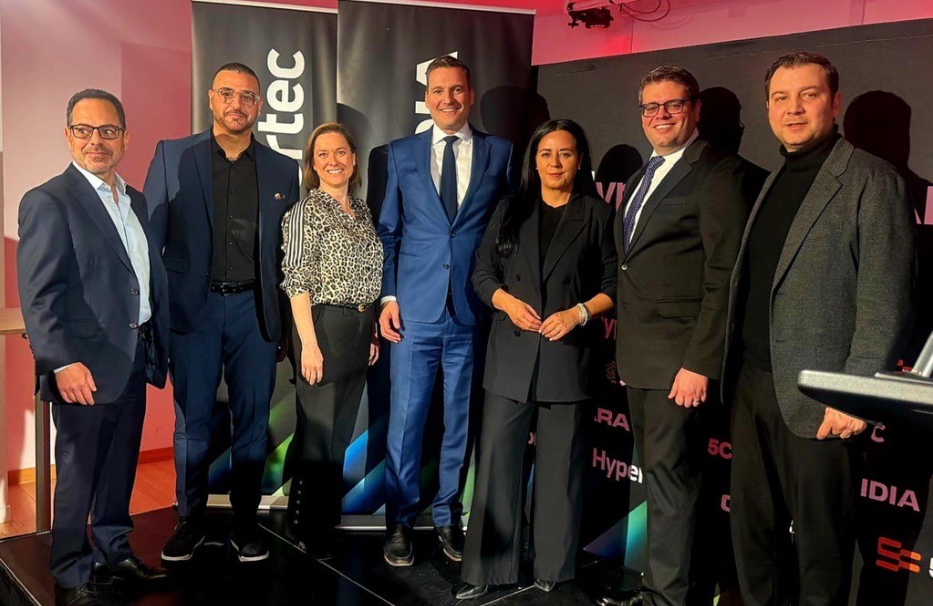
What This Actually Means
While on the surface this appears to be a manufacturing announcement, its implications are far more fundamental: Canada now has sovereign control over a critical layer of the AI infrastructure stack. This is a comprehensive sovereign AI infrastructure play, one that secures our domestic supply chain in perfect alignment with the country's national strategy. Crucially, this milestone goes far beyond basic assembly. It introduces advanced design and integration capabilities right here at home, bolstered by direct collaboration with NVIDIA’s engineering teams to ensure the systems meet the absolute highest global standards.
NVIDIA Certified Systems are one of the gold standard for AI infrastructure today. Enterprises need accelerated computing infrastructure that provides the performance, reliability, and scalability to power today’s modern applications. Until now, building and integrating these systems domestically in Canada was not possible. The hardware had to come from elsewhere with all the supply chain risk, cost, and dependency that entails.
Government, healthcare, financial services, and national defence all operate under strict requirements for data sovereignty and supply chain trust, and this represents a major shift for them. It means Canadian institutions can deploy world-class AI infrastructure without compromising on security or residency requirements.

"AI infrastructure is now strategic infrastructure. This breakthrough marks a turning point for Canada. We are building the infrastructure that will define its future."
Simon Ahdoot, CEO of Hypertec Group
Laying the Foundation
Milestones like this don't happen overnight. Don Schlidt, President of HPC and AI at Hypertec, was candid about what it took to get here.

"There are several elements that had to come together for this to be possible. At Hypertec, we've built good muscle around being a partner, growing through partnerships, picking the right partners, and earning the right to claim significant status with key technology leaders such as NVIDIA. We've had a working relationship for several years. We've had good momentum with the Canadian Partner of the Year Award that we've had the last two years. And this caps that off with the opportunity now to co-develop products, which, as we've talked about in our sovereign AI strategy, part of the control that's needed is design control and the things that go into building truly unique, value-added systems. Not just a commodity technology product." Don Schlidt, President of HPC and AI, Hypertec Group
That ability to establish design control translates directly into tangible ecosystem stability. Mike Marracino, President of the HSP division at Hypertec, explained how local manufacturing fundamentally de-risks the North American AI landscape.

"Having NVIDIA OEM manufacturing in Canada improves the stability and reliability of the ecosystem in three simple ways," Marracino noted. "First, it creates stronger supply chains by reducing dependence on overseas manufacturing and lowering risk from geopolitical disruptions. Second, it enables faster deployments and support, allowing for quicker system integration and warranty responses across Canada and the U.S. Finally, it builds greater trust and sovereignty. In short, Canadian OEM manufacturing adds resilience, speed, and confidence to AI infrastructure across North America."
For an infrastructure provider like 5C, the benefits of this partnership go beyond geography, it’s about having the ability to see the roadmap before it arrives. Gaining early access to NVIDIA’s architectures allows for highly proactive engineering.
"It means systems can be designed earlier and more intelligently, instead of reacting after hardware ships," Marracino explained. "Power, cooling, networking, and rack layouts can all be planned in advance, so deployments go faster and with fewer surprises. It helps ensure better performance tuning and reliability from day one, because platforms are validated against what’s coming next. For 5C specifically, that translates into faster rollout timelines, fewer integration risks, and infrastructure that stays perfectly aligned with NVIDIA’s future direction as they scale."
A New Operating Reality for 5C
This announcement represents a structural shift in what 5C can build and deploy at scale.
David Bitton, VP of AI and Product Strategy at 5C, spoke at the announcement event in Montréal, highlighting what this means for the broader ecosystem:

"For years, Canada has been a recognized global leader in AI research. But leadership in AI isn't defined by research alone. It's also defined by who builds the infrastructure, who controls the compute, and who can actually deploy AI at scale. We are no longer just participating in the AI economy, we are building it. With direct access to NVIDIA-Certified Systems manufactured domestically by Hypertec, we can accelerate deployment timelines, improve supply chain resilience, and offer more competitive, sovereign AI infrastructure to customers in Canada and globally. This positions 5C and Canada as a serious contender in the next generation of AI factory development."
The practical implications are significant. Deploying an AI factory at scale is a race against time, every week between groundbreaking and GPUs coming online is revenue left on the table. A domestic supply chain for NVIDIA-Certified Servers shortens that window. It mitigates cross-border logistical risks, and adds a vital layer of predictability to large-scale deployment operations.
Hypertec and 5C operate as a tightly integrated infrastructure stack, spanning from chip to server, from server to cluster, and from cluster to a fully optimized AI factory, all within Canada, as described by David Bitton.
The Bigger Picture: Sovereignty and Scale
The global AI infrastructure market is regionalizing. The era of a single, frictionless global supply chain for compute is often giving way to sovereign, continent-level stacks, driven by geopolitics, security requirements, and the strategic importance of controlling your own AI destiny.
Canada is now a real player in that conversation.
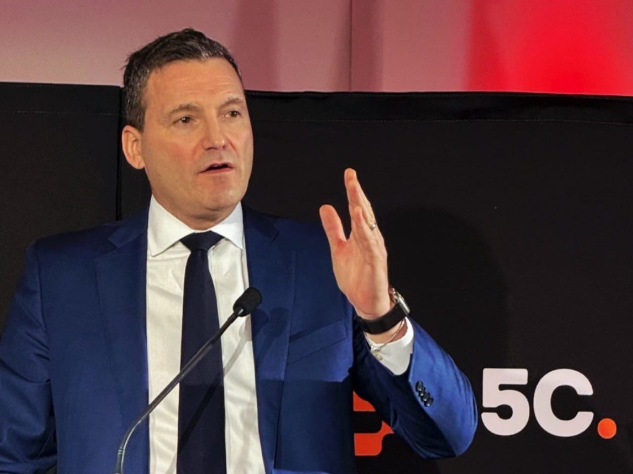
The Honourable Evan Solomon, Canada's Minister of Artificial Intelligence and Digital Innovation, framed it clearly at the announcement: this is about strengthening the domestic supply chain, creating high-skilled jobs, and ensuring Canada can build, deploy, and scale world-class AI infrastructure at home.
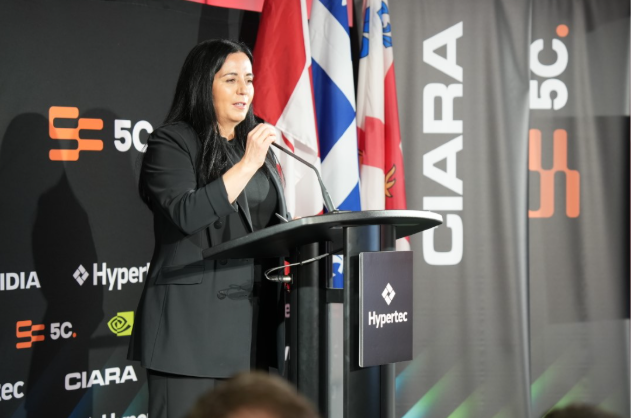
Soraya Martinez Ferrada, Mayor of Montréal, added that Montréal - already home to one of the world's most recognized AI ecosystems, is exactly where this kind of investment belongs. This sentiment was recently put into action with the announcement of a $250 million LaSalle campus and Sovereign AI Research Hub, a landmark joint initiative between Mila, 5C, and Hypertec that further solidifies the city's role as a global powerhouse for both AI research and infrastructure.
What Comes Next
This announcement accelerates opportunities for 5C across the AI infrastructure stack, fewer dependencies, greater control, and faster paths from system design to deployment at scale.
At the national level, the gap between AI research and the infrastructure to support it in Canada is narrowing.
The foundation is in place, and the path to building and deploying at scale is now more direct.
Want to learn more? Contact us.
References
Press release (Hypertec):
Hypertec Group. (2026, April 9). Hypertec’s CIARA division becomes first Canadian NVIDIA OEM partner manufacturing systems in Canada, unlocking a multi-billion-dollar leap in sovereign AI infrastructure. Read press release
CIFAR – Canada as AI leader:
Canadian Institute for Advanced Research. (n.d.). Pan-Canadian artificial intelligence strategy. Visit page
5C / Mila / Hypertec announcement:
5C Group. (2025, September 25). Mila, 5C and Hypertec announce $250 million LaSalle campus and sovereign AI research hub to strengthen Canada’s role as a global leader in AI innovation. Read announcement
ACM Turing Award page:
Association for Computing Machinery. (2018). About the A.M. Turing Award. Visit page
.jpg)